
“In our life there is a single colour, as on an artist’s palette, which provides the meaning of life and art. It is the colour of LOVE”
Marc Chagall
This sentence on its own captures the meaning of Chagall’s life and art. Marc Chagall, was a painter and a poet from Belarus, a man gifted with so much passion and genius in his art he witnessed in a concrete fashion the importance love had in his life. Love has been an underlying force in his life most salient moments. Love for life, for art, for a woman, for his roots and for theatre. When he was only 23, showing great will and courage, he obtained the residence permit, needed by Jews to visit the Russian capital city; and so he left for Saint Petersburg with his friend Victor Mekler in the cold winter of 1906.
“With my 27 roubles in my pocket, the only money my father ever gave me for a journey, I disappear, still rosy-cheeked and curly-haired, to St. Petersburg, accompanied by my friends. The die is cast.” This period of great artistic growth and experimentation, gave life to several works that testified the artist’s qualities. (Reclining nude, The Holy Family, The Russian wedding, Birth). It is indeed in this painting that we find two of the most important themes for Chagall: theatre and the Jewish heritage.
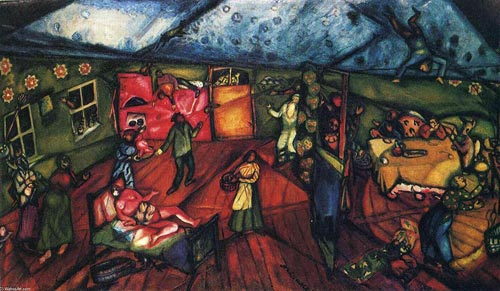
The structure of Birth follows the rules of a theatrical play, with a stage and actors: the wan mother, a sombre midwife who holds the newborn rather uncomfortably and, on the other side, the father, lost in conversation with several curious neighbours: an old Jew with his cow and other people, peeping through the window. A portrayal of “Nativity” which expresses scenes so familiar to the artist.
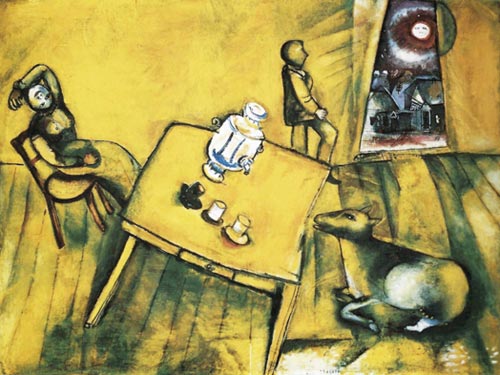
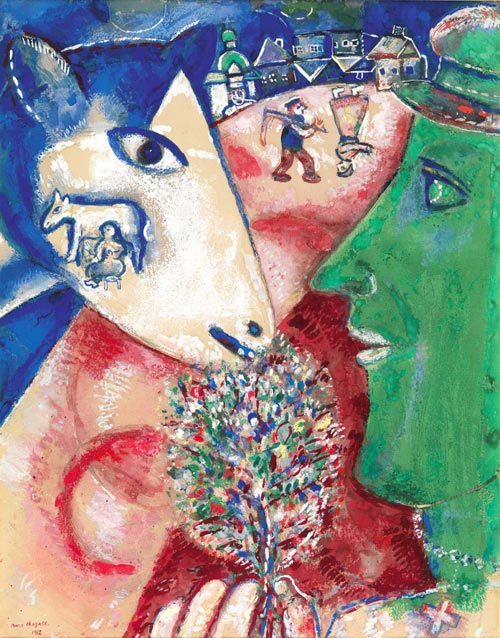
Later on, his love for art would make him travel further and all the way to Paris, the artist ‘cradle, where Chagall joins those who belonged to the avant-garde trend, like Archipenko, Modigliani, and Apollinaire and begins experimenting with new shapes. Fascinated by cubism, he will maintain his passion for colour. Although at the time based in la Ruche, in Montparnasse, Chagall continues to live in the fantastic world of his village, Vitebsk, which comes back strong, together with his Russian roots in this first Parisian phase. One just has to look at works like The yellow room, I and the village, Interiors II in order to realise how much of his recent past and of his heritage were still hunting him and his art “Only the great distance that separates Paris from my native town prevented me from going back”.
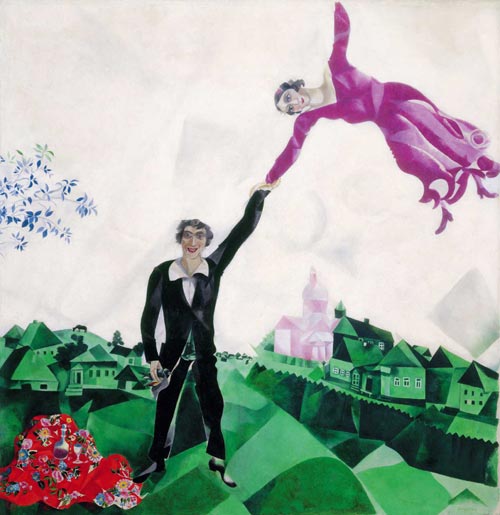
His return home gives birth to a new creative wave, which allows him to draw again from his origins whilst giving them a new perspective, enriched of the Parisian experience. On this occasion, he will marry Bella Rosenfeld, his first love and muse for so much part of his life. This love will completely permeate his ego and reflect its dynamism through works such as The Anniversary (1915), but also Bella with white collar (1917) and The Promenade (1917-18).”In the mornings and evenings, she would bring to my studio cakes she had baked with loving care, fried fish, boiled milk, colourful fabrics, and even boards of wood to use as an easel. All I had to do was open my window,” writes Chagall, “and in streamed the blueness of the sky, love and flowers with her. Dressed all in white or all in black, she has been hunting my paintings, the great central image of my art”.
So much love, passion and sensibility did not prevent the artist from seeing what was happening in the world around him, and already towards the end of the 20s, he had developed a deep awareness of the destiny, which loomed over the Jewish people. His art changes and colour become darker and gloomier filled with shadows and symbols: a mix the New and the Old Testament. Landscapes that set the stage for the Jewish religion under threat from Nazism highlight the persecution that lead the artist to flee to the US with his family.
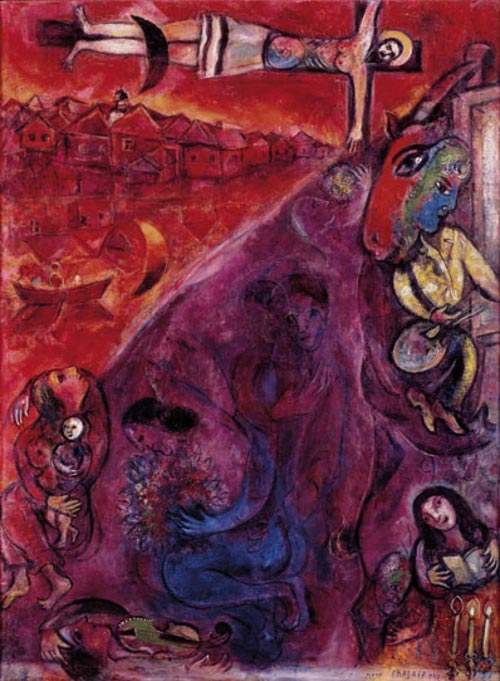
The errant Jew, a protagonist that comes back at different times in his work, starts possessing the artist’s personality, slowly and relentlessly passing on a dimension, linked to a parallel travel, suspended between life and art. With a love-filled heart, Chagall sows dreams and branches of joy, while he continues his wandering search for truth and beauty from within his works deep down into our souls.
You can visit the Expo-Chagall at the Royal Museum of Fine Arts in Brussels and discover over 200 works from all over the world in honour of this majestic retrospective, open to the public until the 28th of June 2015.
Didascalie immagini
- Marc Chagall, The Birth, 1911, Oil on cavas, cm 46×36, private collection
- Marc Chagall, The Yellow room, 1911, Oil on canvas. Basel, Fondation Beyeler
- I and the village, 1912. Pencil, watercolour and gouache on paper. Royal Museums of Fine Arts of Belgium, Brussels, inv. 11108
- Marc Chagall, The Promenade, 1917-1918, Oil on canvas. State Russian Museum, Saint-Petersburg
- Marc Chagall, Resurrection on the riverbank, 1947, Oil on canvas. Private Collection
In copertina:
Marc Chagall, The Birth, 1911, Oil on cavas, cm 46×36, private collection
[particular]
Dove e quando
Evento: Marc Chagall. A retrospective (1908 – 1985)
- Fino al: – 28 June, 2015
- Indirizzo: Royal Museums of Fine Arts of Belgium, Bruxelles
- Sito web